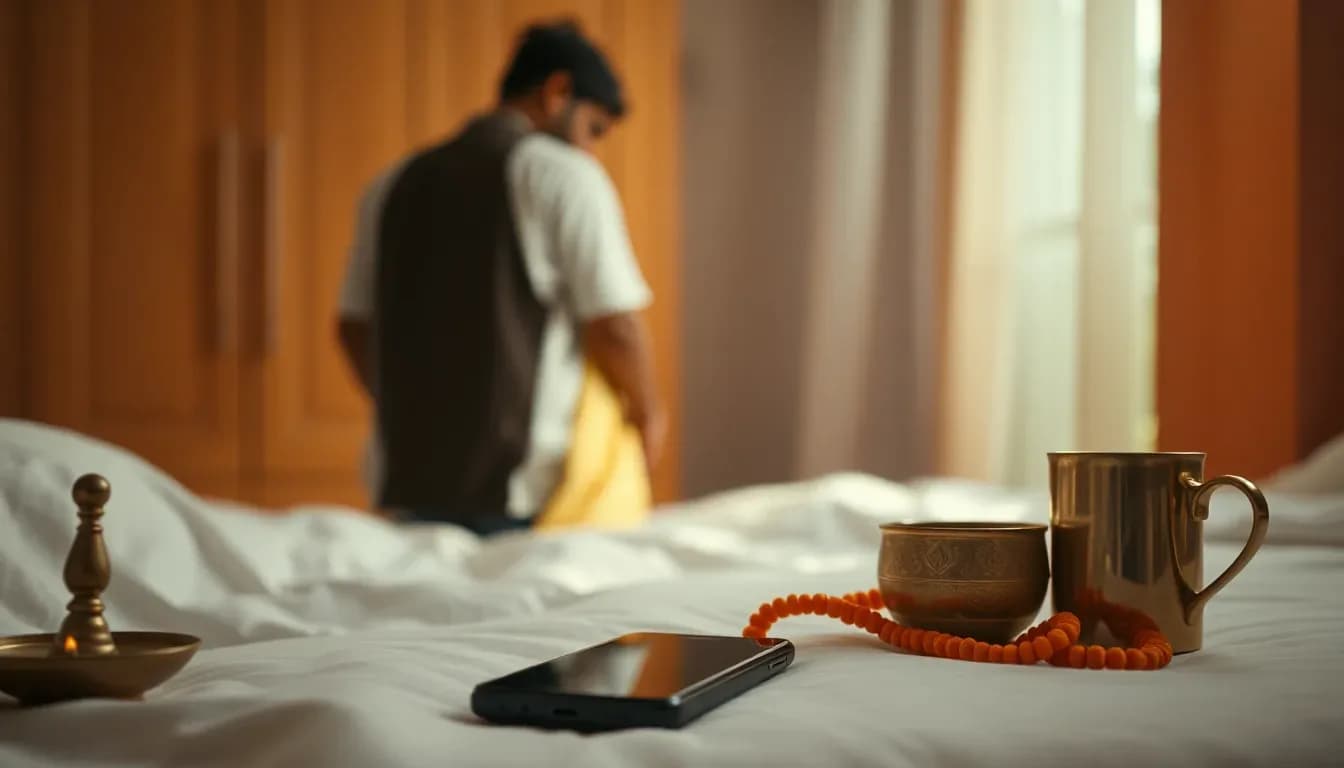
Most South Indian couples do not have sex on their wedding night, and in 2026 that is closer to the norm than the exception. Between a ceremony that starts before dawn, a house full of relatives who are still awake, and a tradition that in many families deliberately schedules the first night for a different date entirely, the wedding night is usually the least likely night for it to happen. If you are searching this question a few weeks before your own wedding, the useful answer is that there is no schedule you are behind on. This article covers what the customs actually say, what couples report doing now, and how to talk about it with the person you just married.

The tradition already separates the two things
This is the part that surprises people, including many South Indians who grew up around it without asking.
In many Tamil families, the first night has its own occasion, commonly called the Shanthi Muhurtham, and it is fixed on an auspicious date decided by the family. That date is frequently not the wedding day. It can be the following night, or several days later, chosen around the calendar rather than around the couple. Telugu, Kannada and Malayali families have their own versions and their own names, and the details differ considerably from community to community, but the underlying structure recurs: the wedding and the first night are treated as two separate events.
So the premise behind the question, that the wedding night is the expected night, is largely a north Indian and film-industry framing. The traditional South Indian arrangement often assumes a gap. Which means a couple who does not sleep together on the wedding night is not deviating from anything.
What actually happens now
The practical reality has moved further still. In the couples we hear from, three patterns cover most weddings.
The most common is exhaustion. A South Indian muhurtham can begin at 5 AM, the reception runs to midnight, and by the time the last relative is fed, both people have been awake for twenty-two hours in heavy silk. What happens is sleep. Frequently one of them is asleep before the other has finished removing jewellery.
The second is logistics. The bedroom is decorated, the house is full, and there are cousins in the next room and an aunt who will knock at seven with coffee. Privacy in a home that has just hosted three hundred people is theoretical.
The third, and increasingly the most deliberate, is choice. Couples in arranged matches especially are choosing to wait until they know each other, and are saying so to each other in advance. Waiting a week, or until the honeymoon, or until it simply happens, is now an ordinary decision rather than a confession of a problem.
Pro Tip: think of it like an IRCTC booking made months ago for a specific train. The date was fixed by someone else's calendar long before anyone asked whether you would feel like travelling that day. You are allowed to look at the itinerary and decide the journey starts tomorrow instead.
The conversation worth having beforehand
One short conversation removes almost all of the anxiety, and the best time for it is a week before the wedding, not on the night.
Say the plain version. "I do not think anything has to happen that night. Let us just see how we feel." That single sentence does an enormous amount of work, because in most cases both people were privately worried about disappointing the other, and neither had a way to say so. Whichever of you says it first is doing the other a favour.
If you are marrying someone you have known for three weeks, add the second sentence: "I would rather we know each other a bit first." Naming it removes the fear that a slow start means something is wrong.
Our guide to what really happens on the first night after an arranged marriage covers the fuller version of this conversation, including what to do if the two of you want different timelines.

If it does happen that night
Some couples do want to, and there is nothing wrong with that either. A few practical notes, because nobody tells anyone these.
Eat something first. Most brides and grooms have eaten almost nothing all day, and low blood sugar plus dehydration is a real cause of what people later interpret as nerves or a physical problem.
Take the jewellery off properly and give yourselves an hour of ordinary conversation before anything else. The single biggest predictor of a first night going well is whether the two of you had actually spoken that day, not whether either of you knew what you were doing.
Go slowly and expect it to be a bit awkward. First-time discomfort or pain is common and usually about tension rather than anything structural. Stopping is always allowed and should not be treated as a failure. Our calm guide to preparing for honeymoon sex covers the practicalities properly, and what to actually expect on a honeymoon in India is the wider picture for the days that follow.
The pressure comes from outside, and you can ignore it
Almost every couple describes the same background noise: the pointed questions at breakfast, the cousin who thinks the teasing is funny, the WhatsApp group that has opinions. In a joint family the room next door is occupied and everyone knows the geography of the house.
None of this is a reason to do anything on a schedule. The couples who report the smoothest transition into married intimacy are consistently the ones who treated the first month as the unit rather than the first night. What matters is that the two of you agree on the pace, privately, and then present a united and completely uninformative front to everyone else. "We are fine, thanks" is a complete sentence and a complete answer.
If nerves are the main thing standing in the way rather than logistics, how to calm down before the first night covers what actually helps in the hours beforehand.
Frequently asked questions
Do South Indian couples have sex on the wedding night? Most do not. The day typically starts before dawn and ends past midnight, the house is full of relatives, and many families follow a tradition that fixes the first night on a separate auspicious date. Sleeping is by far the most common outcome.
What is Shanthi Muhurtham? It is the occasion marking a couple's first night, observed in many Tamil families and with equivalents in other South Indian communities. It is often scheduled on an auspicious date chosen by the family, which can fall a day or several days after the wedding itself.
Is it normal to wait after the wedding in South India? Yes, and it is increasingly deliberate. Couples in arranged matches commonly agree to wait until they know each other better, and tradition in much of South India already assumes a gap between the wedding and the first night.
How long do most couples wait? There is no standard. Some couples wait a few days for the appointed date, many wait until the honeymoon when privacy is finally available, and some wait weeks. The only timeline that matters is the one the two of you agree on.
What should we do if one of us wants to wait and the other does not? Say it out loud before the wedding rather than negotiating it at midnight in a decorated room. The person who wants to wait sets the pace, and the other person naming that clearly, without disappointment, is what makes the eventual first time relaxed instead of loaded.
There is no deadline here, and there never was one. The wedding was scheduled by a calendar. This part is scheduled by the two of you.
Want to explore more?
Arranged Marriage First Night: What Really Happens →
Honeymoon Sex in India: What to Actually Expect →
Honeymoon Night Nerves: How Indian Couples Can Calm Down Beforehand →
How to Prepare for Honeymoon Sex: A Calm Guide for Couples →