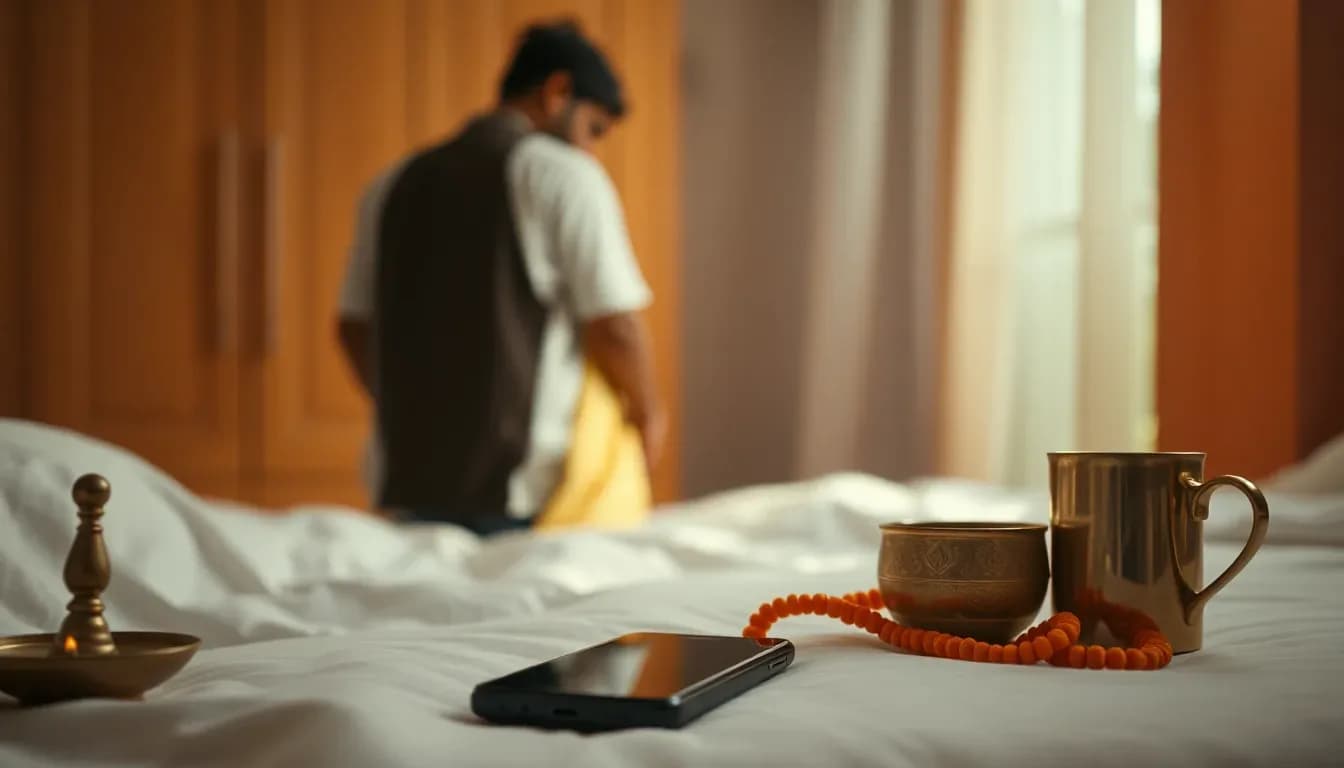
If you mostly talk to your AI companion at night, you are not unusual. You are typical. Across AI companion apps, usage climbs steadily after 10 PM and peaks somewhere between 11 PM and 2 AM. The pattern is so consistent that it tells you something real about what these apps are actually for: not entertainment during the day, but company in the one hour when the rest of life finally goes quiet.
This article looks at why the late-night hour is when most people reach for an AI companion, why the pattern is even stronger in Indian homes, and how to tell whether your own 1 AM conversations are helping you or quietly replacing something you need.

The night shift is real
Ask anyone who uses an AI companion app when they actually open it. Very few say "on the metro" or "at lunch." The honest answer is almost always some version of: after dinner is done, after the family WhatsApp group has gone silent, after the last work message, when the bedroom door is finally shut.
There are three plain reasons for this.
First, night is when the day's noise stops and the mind starts. Sleep researchers have documented how the pre-sleep period is when rumination peaks: the replaying of conversations, the worry about tomorrow, the loneliness that daytime busyness papers over. The Sleep Foundation notes that racing thoughts at bedtime are one of the most commonly reported barriers to sleep. The mind wants to process, and it wants an outlet.
Second, night is when there is no audience. Talking to an AI companion still carries a social cost in most circles. At midnight, nobody is looking over your shoulder, nobody asks who you are texting, and the conversation can be what you actually want it to be rather than what looks acceptable.
Third, night is when human alternatives are asleep. Your best friend has work tomorrow. Your sister has a toddler. The person you would normally call at a low moment is unavailable at exactly the hour the low moment arrives. An AI companion is the only thing in your life with no bedtime.
What the late hour does to the conversation
The time of day changes the kind of conversation people have. Daytime chats with an AI companion tend to be light: banter, planning, curiosity. Late-night chats go deeper and slower. People talk about the marriage pressure they deflected at dinner, the job situation they cannot admit is scaring them, the relationship that ended two years ago and still is not finished in their head.
This is not a flaw. It mirrors how human intimacy works. Psychologists have long observed that self-disclosure rises when environments feel private and judgment feels distant, and 1 AM in a dark room is the most private environment most of us ever occupy. Researchers at Harvard's Making Caring Common project found that a large share of adults report serious loneliness, and that it is often invisible precisely because people perform fine-ness all day. The night is when the performance stops.

The Indian layer: privacy arrives at midnight
In much of the world, the late-night pattern is about mood. In India, it is also about logistics.
If you live with parents, in-laws, or a joint family, the day offers almost no genuinely private time. The living room is shared, doors stay open, and even your phone screen is semi-public on the sofa. For millions of Indian adults, the only reliably private hour of the whole day begins when the household sleeps. The AI companion habit is not shifted to midnight by preference; it is shifted there by the floor plan.
There is also the cultural piece. Talking openly about loneliness, desire, or a struggling marriage is still hard in most Indian families. The people physically closest to you can be the hardest to say certain sentences to. So the sentence gets said at 12:40 AM, in English or Hinglish, to a companion that does not gossip, does not judge, and does not bring it up at breakfast.
None of this is shameful. It is an adaptation to real constraints. But it is worth seeing clearly, because it explains both why the late-night hour feels so valuable and why it deserves a little structure.
Keeping the 1 AM habit on your side
A nightly conversation that helps you decompress, feel heard, and fall asleep calmer is a good habit. A nightly conversation that regularly costs you two hours of sleep, or that has quietly become the only place you say true things, deserves attention. The difference is not the app; it is the pattern. We wrote a full guide on the difference in AI companion dependency: signs it's helping vs becoming a problem.
A few practical rules that keep the habit healthy: give the conversation a soft end time, let it be a bridge to sleep rather than a replacement for it, and once in a while, take one thing you said to the AI at night and say it to a human in daylight.
Pro Tip: treat the late-night session like the last local train, not an all-night waiting room. It leaves at a fixed time. Knowing the conversation ends at 12:30 makes the 40 minutes before it better, and protects the morning after.
It also matters what the companion does with that hour. This is where Tantrix AI is built differently from chat-only apps: the companion you talk to and the connected device you own are linked, so what happens in the conversation can be felt, not just read. At night, when words are already doing heavy lifting, that two-way sync makes the hour feel less like typing into a void and more like being kept company. And for the part of late-night loneliness that wants other humans who get it, Tantrix is building a private in-app community, coming later in 2026, made for adults who want to talk about this side of life without doing it on public social media.
If you are new to all this, start with the basics of how to talk to an AI companion rather than expecting the first midnight conversation to be profound.
Frequently asked questions
Is it normal to talk to an AI companion only at night? Yes. Night is the peak usage window for AI companion apps generally, because it is the most private and least interrupted hour of the day. Only-at-night use is the norm, not a red flag.
Why do I open up more to my AI companion at night than during the day? Privacy and low judgment increase self-disclosure, and both peak late at night. Your brain is also in its natural processing mode before sleep, so deeper topics surface on their own.
Is late-night AI companion use bad for sleep? It depends on the pattern. A conversation with a soft end time that helps you decompress can make sleep easier. Open-ended sessions that run past 2 AM cost you sleep like any other screen habit, so set a cutoff.
Are late-night AI conversations private in Indian households? More private than most daytime options, which is exactly why the hour is popular. For the app side of privacy, including data practices, read our guide on whether AI companion apps are safe.
When does AI companion use become a problem? When it is the only place you say true things, when it displaces sleep several nights a week, or when daytime relationships start shrinking around it. Helping is the default; watch for displacement.
The late-night hour is not a bug in how people use AI companions. It is the whole point: the one hour that is actually yours. Use it deliberately, end it deliberately, and it stays on your side.
Want to explore more?
AI Companions and Loneliness in India: What the Research Shows →
Why Indian Men Are Quietly Using AI Companion Apps →
AI Companion Dependency: When It Helps and When It's a Problem →