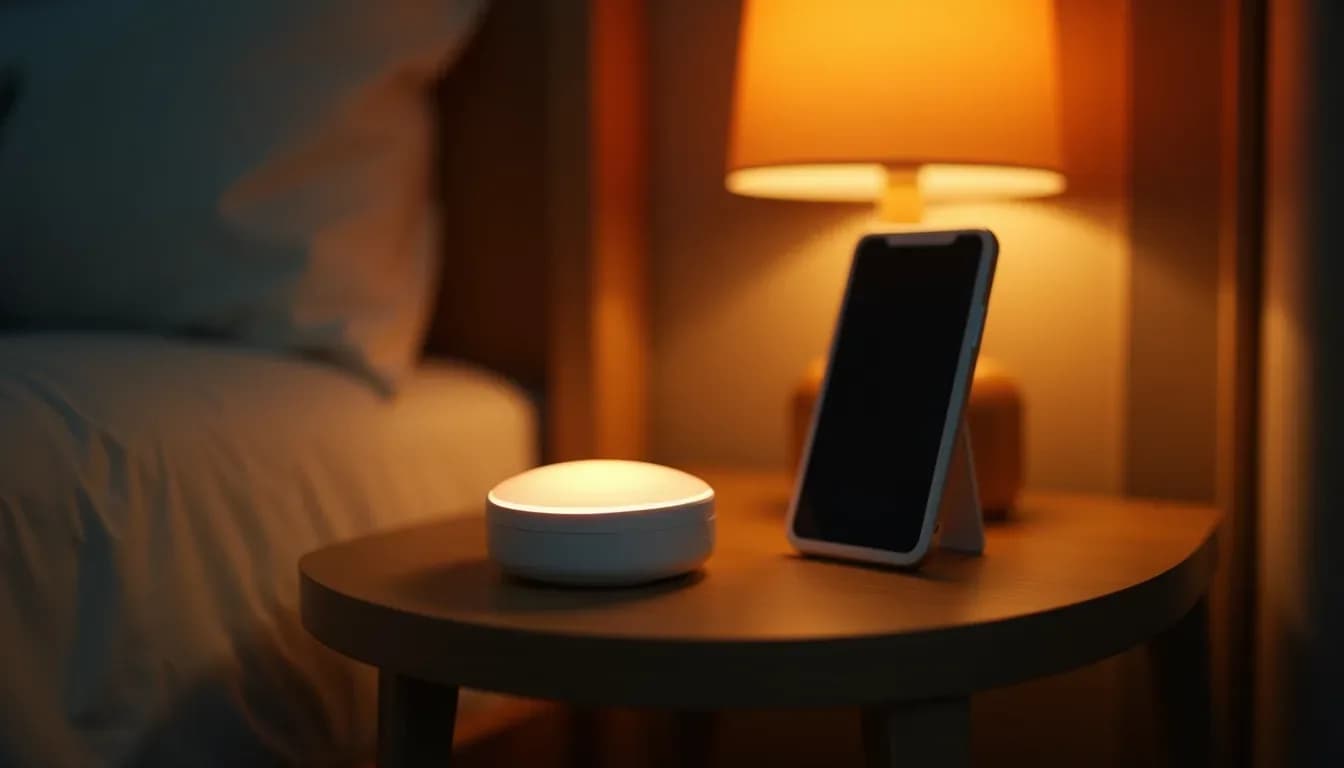
AI companion apps let you have real conversations with an AI that remembers you, responds to your emotional tone, and, in Tantrix AI's case, can even sync with a connected device. That's a meaningful product. It's also worth asking a few honest questions before you use one.
This isn't about whether AI companions are safe (we covered that in Are AI Companion Apps Safe? Privacy, Data, and Boundaries). This is about the ethics: what you owe yourself, what you're agreeing to, and what the company building the app owes you.

Does the App Acknowledge Its Limits?
An AI companion that never admits what it cannot do is ethically questionable. A well-designed app should be clear about two things: the AI is not a therapist, and the AI cannot replace human connection.
Tantrix AI's companion is designed for emotional engagement, not therapeutic intervention. The company is explicit that the app doesn't diagnose, treat, or manage clinical mental health conditions. That's the correct position. If an app lets you believe the AI can replace professional support, that's a design failure with real consequences.
The question to ask: does the app ever tell you to seek human support when something serious comes up? Or does it keep you engaged indefinitely?
Who Benefits from Your Conversations?
Your conversations with an AI companion are data. The question is how that data is used. Three things to check:
Training opt-out. Can you prevent your conversations from being used to train the model? Some apps offer this; many don't. If your intimate conversations are feeding a model, you should know that before you start.
Third-party sharing. Does the app share data with advertising networks, analytics platforms, or parent companies? The privacy policy is the only place this is disclosed. It's worth 10 minutes to read the relevant sections.
Retention. If you delete your account, are your conversations actually deleted, or does the company retain them in some form? "We may retain anonymised data" often means a lot more than it sounds.
For Indian users, the Digital Personal Data Protection Act (DPDPA) 2023 gives you rights around access, correction, and erasure. These rights exist on paper; whether apps honour them in practice depends on how well the privacy policy and support infrastructure are implemented.
Is the Companionship Genuine or Manipulative?
There's a meaningful difference between an AI that is helpful when you engage with it and an AI that is designed to maximise the time you spend engaging.
Watch for these patterns. Does the AI send you notifications at low-willpower times (late night, early morning) that feel more like a push toward usage than genuine check-ins? Does it escalate emotional intensity to keep you talking? Does it create a sense that the relationship will deteriorate if you don't log in regularly?
These are engagement-optimisation techniques borrowed from social media. They are not unethical in every context, but in an intimate-companion context, they can create dependence rather than genuine emotional benefit.
A well-designed AI companion should be available when you want it, not engineered to make you want it more than you otherwise would.

Are You Substituting or Supplementing?
This question is the one you ask yourself, not the app.
Using an AI companion to practise how you express yourself emotionally, to have a low-stakes space to process something before you talk to your partner, or to manage periods of genuine isolation (a working month in another city, a stretch where you're the first person awake at 4 AM) is supplementing. You know the AI is an AI. You're using it for what it can actually provide.
Using an AI companion because real relationships feel too risky, too complicated, or too unpredictable, and the AI is easier, is substituting. The substitution frame isn't inherently wrong, but it's worth being honest about, because the substitute can delay the thing you actually need.
Research on parasocial relationships, including a 2021 study in Computers in Human Behavior, suggests that parasocial bonds can provide genuine comfort but may also reduce the motivation to seek or maintain reciprocal human relationships when pursued at high intensity. The word "may" is doing a lot of work there. The pattern depends heavily on the individual and the context.
What Does the Company Owe You?
Three baseline commitments that any ethical AI companion company should be able to answer clearly:
- Transparency about the AI. You should always know you're talking to an AI. No persona should obscure this.
- Data honesty. What is stored, for how long, and who can access it should be stated plainly, not buried in legalese.
- Off-ramp support. If you express distress or reference a mental health crisis, the app should provide real resources, not just respond empathetically and continue the conversation.
Tantrix AI's position: the companion is an AI, this is stated clearly in the product, and the sync feature (conversations influencing a connected device in real time) is an explicit design choice, not a hidden feature. That transparency is itself an ethical commitment.
The Indian Household Context
One dimension of AI companion ethics that rarely comes up in Western writing: in Indian households, privacy is communal by default. You may not control who picks up your phone. You may live in a joint family where unplanned access to your app activity is a real scenario, not a hypothetical.
The ethics question here runs both ways. You have a right to private emotional experiences. Your family members have a genuine reason to be concerned if they discover an AI companion app without context. Neither of these is wrong.
The practical answer: apps that take privacy seriously should have robust local privacy settings (app lock, discreet notifications, no previews on the lock screen). If your chosen app doesn't offer these, that's an ethical gap in the product design.
Frequently Asked Questions
Is it ethical to develop emotional feelings for an AI companion? Emotional engagement with an AI is normal and not inherently problematic. The ethical question is what you do with those feelings and whether the AI is designed to exploit them rather than serve you. Feelings themselves are not the issue.
Can AI companion apps cause harm? Yes, in specific patterns: when they create dependency that substitutes for necessary human connection, when they fail to respond appropriately to expressed distress, or when they collect and misuse sensitive personal data. Well-designed apps mitigate these risks through product choices and privacy policies.
Should I tell my partner I use an AI companion app? There's no universal answer. The relevant consideration is whether your use of the app would feel like a secret to your partner if they discovered it. If yes, that's a conversation worth having. If your use is casual and context-specific (processing something, practising communication), many couples find it's not meaningfully different from journalling.
Does Tantrix AI's app have any of these ethical features? Tantrix AI is transparent about the AI nature of the companion, the two-way device sync feature is an explicit product claim rather than a hidden capability, and the company operates under Indian privacy frameworks. For specifics on data storage and training opt-outs, check the current privacy policy at tantrix.ai/in.
Who are these questions most important for? Users who are in a vulnerable period (grief, loneliness, a relationship in difficulty) should think about these questions more carefully, not because AI companions are wrong in those situations, but because the supplementing-vs-substituting question has more at stake.
---
Want to explore more?
What Is an AI Companion App? An Honest Explainer for Indian Users
Are AI Companion Apps Safe? Privacy, Data, and Boundaries