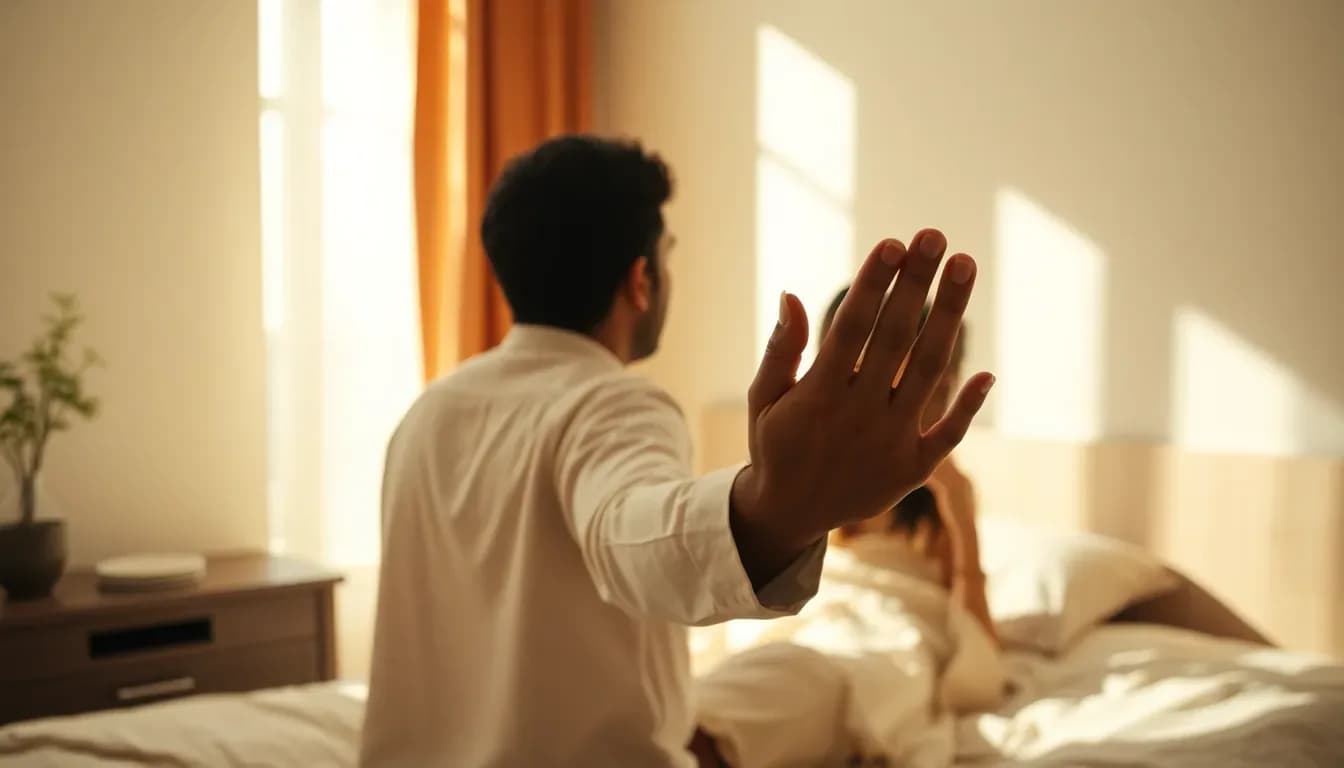
Roleplay is one of the most commonly fantasised bedroom activities that Indian couples never actually try. The barrier is almost never desire: it is the fear of saying something that will make your partner laugh at you, or start something you do not know how to finish.
That is an execution problem, not a desire problem. And like most execution problems, it has a straightforward fix. Roleplay works best when you choose a low-stakes scenario, set it up in advance, and give each other a clear, easy exit. The elaborate full-costume production is optional. The basic structure is not.

Why Roleplay Feels Awkward Before It Feels Good
The awkwardness is structural. In everyday life, you and your partner know exactly who each other are, what you find funny, what you find boring, and how you respond when something feels forced. Roleplay asks you to temporarily pretend you do not know any of that, which is a lot to ask in a bedroom that also contains the laundry pile and both your phones.
The solution most advice gives is "just commit to the character." That is bad advice for beginners, because it sets up a performance standard that creates more self-consciousness, not less. The better frame is: you are not performing for each other. You are playing a game together, and the goal of the game is to shift the emotional register of the interaction, not to fool anyone into believing you are actually a stranger at a hotel bar.
When couples approach it as play rather than performance, the awkward-to-good ratio shifts considerably. You are allowed to laugh. You are allowed to break character and go back to being yourselves for a minute. What you are doing is exploring whether a different dynamic between the two of you feels interesting, not auditioning for a role.
Pro Tip: Think of your first roleplay like IRCTC waitlist booking. You are not expecting a perfect seat guaranteed. You are testing a process, and success means you get comfortable enough to book again. The second time is always smoother than the first.
Choosing a Scenario That Actually Fits
The scenario should feel plausible in the emotional register you are aiming for, not impressive on paper. The "two strangers who meet at a bar" scenario is popular in advice columns because it creates obvious narrative distance. But if neither of you goes to bars, it is also harder to inhabit.
Better starting points for Indian couples: a scenario with an inherent power shift that does not require elaborate setup. "Interviewer and job candidate" gives one person a formal posture and the other a seeking posture. "Hotel guest and concierge" works on any overnight trip and barely requires explanation. "Person who has never done this and person who knows exactly what they are doing" is almost a meta-description of roleplay itself and works because it is honest.
Choose the scenario together, before the moment you want to try it. This is the single most important logistical point. A scenario chosen mid-situation puts someone on the spot and usually results in one person narrating uncertainty while the other waits. A scenario agreed on in advance, even just "next Friday evening, we are doing X," turns that Friday evening into something you have both been anticipating rather than awkwardly initiating.
Consent and easy exit language belong here too. "We can drop the scenario whenever either of us wants to" is worth saying out loud before you start. It does not kill the mood: it removes the social ambiguity of whether breaking character is allowed, which actually frees both people up to stay in it longer.
The Setup: From Ordinary Evening to Scene
The hardest transition in any roleplay is the three minutes between "we are having dinner" and "we are in the scenario." Getting that transition wrong is what makes most first attempts feel self-conscious.
The simplest method: give yourself a setup cue, something small and specific that signals "we are starting now." This could be something as simple as one of you leaving the room and returning, or a specific phrase, or putting the phones in a drawer and turning the main light off. The cue does not need to be elaborate. It just needs to be agreed on, so you both know when the game has started.
Keep the early dialogue minimal. Roleplay novices try to narrate everything ("so you are a stranger and I am also a stranger and we have never met before"), which breaks the spell immediately. The scenario works better when you start from the middle of the implied situation rather than from the beginning. If you are playing strangers at a hotel, do not explain that you are strangers. Just behave like one person who does not know the other and let your partner respond.

Indian Household Reality: Adapting for Your Actual Life
The 11 PM Tuesday version of bedroom roleplay is different from the version in a weekend hotel room, and most advice is written for the hotel-room version.
For the home version, the main adjustment is sound management. Most Indian apartments have walls that carry sound, and a shared flat or joint family context makes extended vocal immersion impractical. This shifts the weight of roleplay toward body language, gesture, and written elements, specifically text.
A surprisingly effective adaptation: run the scenario over WhatsApp before you are in the same room. One of you messages the other from a different room, in character. This gives you both a way to test the scenario's feel, develop it at your own pace, and edit before you send. By the time you are physically together, you have already established the dynamic and neither of you is starting cold.
The Tantrix Moh works naturally in D/s-leaning roleplay scenarios where one partner holds the app and the other wears the device. The scenario does not need to be elaborate for this to add a real dynamic shift: one person literally controls what the other experiences, which is the functional core of most roleplay that involves a power imbalance. You do not need costumes for that to feel different from a normal evening.
Frequently Asked Questions
Do we need props or costumes to make roleplay work? No. Costumes and props can add atmosphere, but they are not the mechanism by which roleplay works. The mechanism is adopting a different relational dynamic than your usual one. Everything else, including costumes, is set dressing that helps some people inhabit the dynamic more easily. If it helps you, use it. If it creates more pressure, skip it.
What if one of us starts laughing and cannot stop? Laugh. Then decide together whether to resume or call it. There is no failure state in which you both ended up laughing, as long as both of you found it funny rather than one of you feeling mocked. If that distinction is unclear, check in briefly: "are you good? do you want to keep going?" Then proceed or don't.
How do I bring this up with my partner without it being awkward? Bring it up outside the bedroom, when neither of you is tired and there is no pressure to act on it immediately. The framing that works best: not "I want to do roleplay" (too abstract and slightly loaded), but "I have been thinking about trying something, can I tell you what it is?" That structure invites curiosity rather than instant reaction.
Are there scenarios we should avoid as beginners? Yes. Avoid scenarios that require a lot of narrative context to set up, that involve someone playing a role they genuinely feel uncomfortable with (even as fiction), or that depend on props or equipment you have not used before. Begin with scenarios that require minimal explanation and maximum improvisation. Add complexity after you have done it once and know what you both enjoy.
What is the difference between roleplay and BDSM? Roleplay is any scenario where you adopt a different persona or dynamic than your everyday one. BDSM is a specific set of practices involving power exchange, restraint, discipline, or sensation play. The two overlap when roleplay involves a power imbalance, but vanilla roleplay (strangers, professional dynamics) is not inherently BDSM and does not require the same preparation. For articles on BDSM specifically, start with BDSM for Beginners in India.
---
Want to explore more?
BDSM for Beginners in India: Where to Start, Without the Drama →
How to Ask for What You Want in Bed (Without Killing the Mood) →